TMS THERAPY
Welcome to the Future of Mental Health Treatment
TMS at Ally Integrated Healthcare
Revolutionize Your Well-being with Our Cutting-Edge TMS Therapy

GET THE HELP YOU NEED
What is TMS Therapy?
Transcranial Magnetic Stimulation (TMS) is a non-invasive, FDA-approved therapy designed for individuals battling with mental health conditions. Using gentle magnetic pulses, TMS stimulates key areas of the brain involved in mood regulation, offering a new hope for those who haven’t found relief through traditional treatments.
Why Choose TMS at Ally Integrated Healthcare?
- Expert Care: Our team of certified TMS therapists and mental health professionals ensures a personalized and compassionate approach to your wellbeing.
- Innovative Technology: We utilize the latest in TMS equipment, providing effective and safe treatment.
- Comfort and Convenience: Experience a comfortable, outpatient procedure that lets you return to your daily activities immediately with no downtime.
- Proven Results: Clinical studies and patient testimonials underscore the effectiveness of TMS in improving mental health symptoms.
To help us evaluate if you could benefit from this treatment, we ask you to complete the PHQ-10 form.
Your input is crucial for us to provide personalized care. Please contact us if you have any questions.
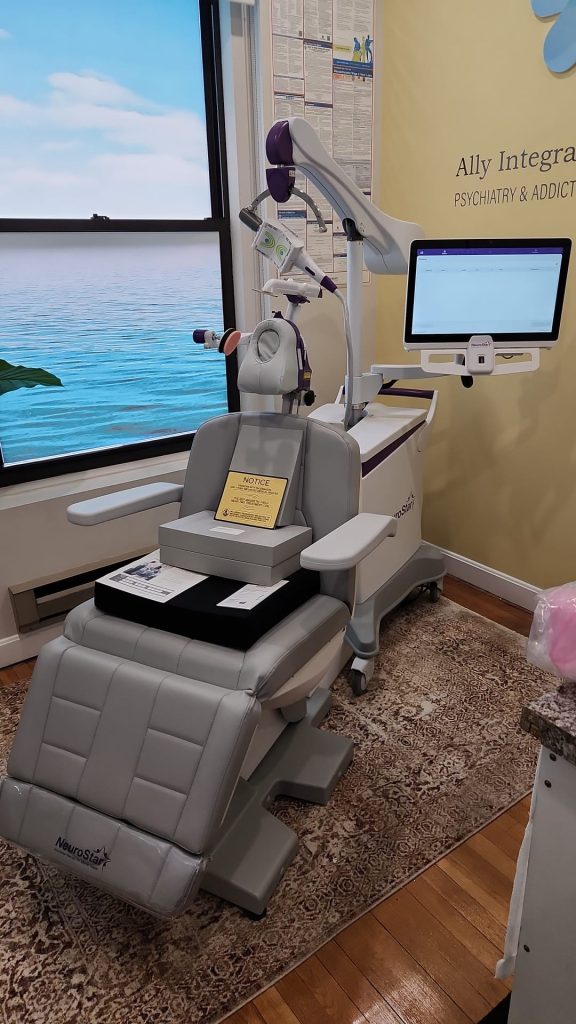
How NeuroStar® TMS Therapy Works
Here’s what you can expect from a NeuroStar Advanced Therapy (TMS) session:
Before Treatment
You’ll recline comfortably in the treatment chair. A small, curved magnetic coil will be positioned lightly on your head.
During Treatment
NeuroStar delivers focused magnetic stimulation directly to the target areas of the brain. You’ll hear a clicking sound and feel a tapping sensation on your head.
After Treatment
NeuroStar Advanced Therapy: Depending on your doctor’s recommendation, each treatment takes between 19 and 37 minutes. You can resume normal activities immediately. Because there are no effects on alertness or memory, you can drive yourself to and from treatment sessions.
In-office treatment with NeuroStar TMS Therapy typically takes 19-37 minutes and is administered 5 days a week for approximately 4-6 weeks.*
Your Journey with TMS
Consultation:
Personalized Treatment Plan:
Ongoing Support:
Patient Testimonials
TMS Clinical Trials & Academic Studies
- Carpenter LL, et al. (2012). Transcranial Magnetic Stimulation (TMS) for Major Depression: A Multisite, Naturalistic, Observational Study of Acute Treatment Outcomes in Clinical Practice. Depression and Anxiety, 29(7):587-596. www.ncbi.nlm.nih.gov/pubmed/22689344
- George MS, et al. (2010). Daily Left Prefrontal Transcranial Magnetic Stimulation Therapy for Major Depressive Disorder: A Sham-Controlled Randomized Trial. Arch Gen Psychiatry, 67(5):507-516. www.ncbi.nlm.nih.gov/pubmed/20439832
- Dunner DL, et al. (2014). A Multisite, Naturalistic, Observational Study of Transcranial Magnetic Stimulation (TMS) for Patients with Pharmacoresistant Major Depressive Disorder: Durability of Benefit Over a 1-Year Follow-Up Period. J Clin Psychiatry. 75(12):1394-1401. www.ncbi.nlm.nih.gov/pubmed/25271871
- O’Reardon JP, et al. (2007). Efficacy and Safety of Transcranial Magnetic Stimulation in the Acute Treatment of Major Depression: A Multisite Randomized Controlled Trial. Biol Psychiatry, 62(11):1208-1216. www.ncbi.nlm.nih.gov/pubmed/17573044
Frequently Asked Questions
Transcranial magnetic stimulation, often referred to as TMS is a noninvasive procedure that uses magnetic fields to stimulate nerve cells in the brain to improve symptoms of depression. TMS is typically used when antidepressant medications haven’t been effective, have ceased working, or as an alternative to medication.
TMS involves delivering magnetic pulses to specific parts of the brain.
A vast majority of commercial and Medicare plans have recognized the effectiveness of treating depression with TMS Therapy and now cover TMS as part of their plans.
TMS therapy is generally well-tolerated and not painful. During treatment, you may feel a tapping sensation on your scalp, which is usually mild. Some people experience slight discomfort or a mild headache, but these effects are typically brief and manageable. Overall, TMS therapy offers a non-invasive way to treat depression with minimal discomfort.
Yes! 83% of patients see significant results. 62% of patients go into remission.
This is the one thing we are missing is does it work versus how does it work.
Private Pay Rates
Payment & Fees
We accept private payments, Blue Cross Blue Shield, Tufts HMO/PPO, ComPsych and Out of Network Benefit plans. We do NOT have contracts with Medicare or Medicaid (MassHealth) plans, as such we can NOT accept these plans.
We provide invoices for patients who wish to seek reimbursement from their insurance company. We accept payments by checks, credit card, HSA/FSA. Credit card payments accepted through the online patient portal. Payment is due at time of service.
| 60 minutes Intake | = | $400 |
| 45 minutes follow up | = | $350 |
| 30 minutes follow up | = | $250 |
| 75 minutes Intake | = | $500 |
| 60 minutes Intake | = | $450 |
| 45 minutes follow up | = | $350 |
| 30 minutes follow up | = | $300 |
| 60 minutes CRAFT based SUD Family Support (8-10 people Max) | = | $75/Person |
| 60 minutes Parenting support group (5-8 people Max) | = | $65/Person |
| 60 minutes LGBTQ Youth/Adolescent support group | = | $65/Person |
| 60 minutes Early Recovery support group | = | $75/Person |
| 60 minutes relapse prevention support group | = | $75/Person |
No Show or late cancelation Fee: $150
Cancelation must be made 48 hours prior to appointment.
HEALTH INSURANCE
Insurances and Health Plans
Please see the insurances and health plans we are contracted with: